
Table of Contents
ToggleAn accent chair does more than fill an empty corner, it defines the room’s character, adds functional seating, and creates visual balance. Unlike a sofa or sectional locked into a layout, accent chairs offer flexibility in style, scale, and placement. Whether flanking a fireplace, anchoring a reading nook, or breaking up a large open floor plan, the right chair transforms a living room from generic to curated. This guide covers classic and contemporary accent chair ideas that work across design styles, budgets, and spatial constraints, with practical tips on selection, placement, and pairing.
Key Takeaways
- Living room accent chairs define room character, add functional seating, and create visual balance without the footprint of a full sofa or sectional.
- Wingback chairs offer timeless elegance with 40–45 inch heights and wings extending 6–8 inches, while mid-century modern chairs provide clean lines and ergonomic curves that work in both retro and transitional spaces.
- Bold accent chairs with vibrant colors and patterns transform a neutral room from generic to curated, but require a defined neutral base to avoid visual clutter.
- Strategic placement of accent chairs—flanking fireplaces, anchoring reading nooks, or opposite sofas—creates conversational groupings and defines zones in open-concept living rooms.
- Performance fabrics and solution-dyed materials in accent chairs resist stains and fading, making them practical for high-traffic homes with kids or pets.
- Sculptural and artistic seating options prioritize form as functional art, but require careful consideration of comfort, integration strategy, and maintenance needs.
Why Accent Chairs Are Essential for Living Room Design
Accent chairs serve three core functions: they add seating capacity without the footprint of another sofa, they introduce contrasting texture or color to break visual monotony, and they define zones within open-concept spaces.
From a layout perspective, accent chairs create conversational groupings. Positioning two chairs opposite a sofa with a coffee table between establishes a natural face-to-face seating arrangement that works better for conversation than a single long sectional. In smaller living rooms (under 200 square feet), a single chair paired with a compact side table can provide flexibility without blocking sight lines or traffic flow.
Material and upholstery choices let homeowners layer textures that complement existing furniture. A leather wingback beside a linen sofa adds tactile contrast: a velvet slipper chair softens a room dominated by wood and metal. This layering prevents the flat, showroom look that happens when all seating matches.
Accent chairs also solve practical problems. In homes with kids or pets, a chair upholstered in performance fabric (solution-dyed acrylic or treated polyester blends) resists stains and wear better than unprotected natural fibers. Chairs with removable, washable covers add another level of maintainability.
Finally, accent chairs anchor design styles. A room can lean traditional, modern, or eclectic based largely on chair silhouette and finish. Swapping out a single accent chair refreshes a space faster and cheaper than replacing a sofa.
Classic Accent Chair Styles That Never Go Out of Fashion
Wingback Chairs for Timeless Elegance
Wingback chairs trace their origin to 17th-century England, where the high back and side “wings” shielded sitters from drafts near fireplaces. Today, they remain one of the most versatile traditional forms.
Silhouette and proportions matter. Classic wingbacks stand 40–45 inches tall with wings extending 6–8 inches beyond the backrest. Seat depth typically runs 20–22 inches: anything shallower feels perched, while deeper seats (24+ inches) suit lounging but may overwhelm petite users. Look for hardwood frames (oak, maple, or beech), avoid particleboard or softwood in chairs that’ll see daily use.
Upholstery options range from nailhead-trimmed leather to patterned linen. Leather (top-grain or full-grain, not bonded) develops patina and withstands years of use: expect to condition it annually. Linen and cotton blends soften the formal look but require Scotchgard or similar treatment to resist spills. Velvet wingbacks work in low-traffic formal living rooms but show wear and watermarks in family spaces.
Placement tips: Wingbacks anchor a fireplace wall when positioned symmetrically on either side. In asymmetrical layouts, a single wingback balances a sofa’s visual weight without requiring a matched pair. Pair with a floor lamp or swing-arm sconce for reading light, the high back supports task lighting better than low-profile chairs.
Mid-Century Modern Chairs for Retro Appeal
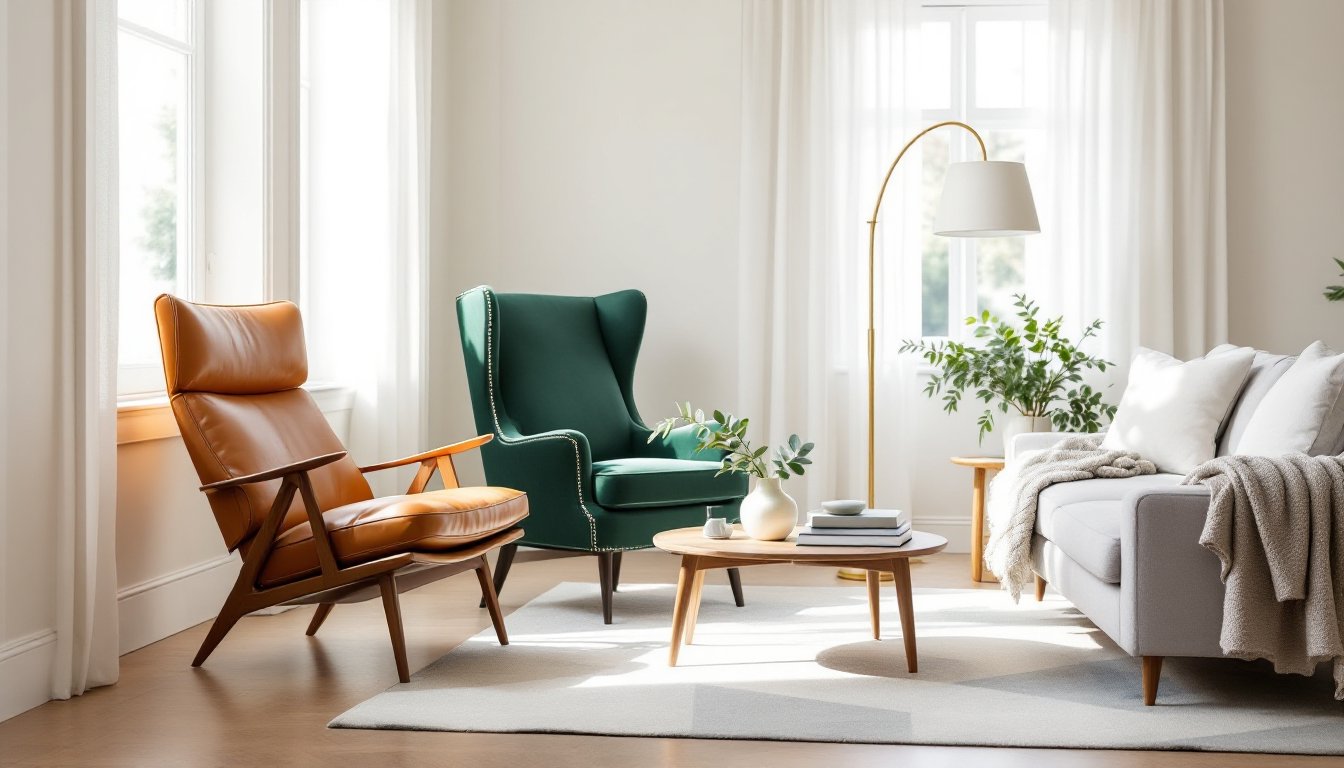
Mid-century modern (MCM) design, roughly 1945–1970, emphasizes clean lines, organic curves, and minimal ornamentation. Iconic examples include the Eames Lounge Chair, Womb Chair, and Egg Chair, though countless affordable reproductions and MCM-inspired designs exist.
Material palette: MCM accent chairs typically combine molded plywood, bent metal (steel or aluminum), and upholstered cushions. Authentic vintage pieces used teak, walnut, or rosewood: modern versions often substitute ash or rubberwood stained to mimic walnut. Check joinery, quality MCM chairs use mortise-and-tenon or dowel joints, not just screws and glue.
Form and function: MCM chairs favor ergonomic shaping over boxy right angles. Curved backs and angled legs distribute weight naturally. Many designs (like the Papa Bear chair or Shell chair) feature waterfall seat edges that reduce pressure on the back of the thighs, a practical detail, not just aesthetic.
Color and finish: Purists stick to natural wood tones, black or cognac leather, and neutral wool upholstery. But MCM style accommodates bold accent colors, mustard yellow, burnt orange, teal, especially in smaller doses like a single accent chair. Powder-coated metal legs in matte black or brass add contemporary flair without sacrificing the retro silhouette.
Pairing advice: MCM chairs work in eclectic and transitional spaces, not just retro-themed rooms. A walnut-legged lounge chair grounds a Scandinavian minimalist living room: a fiberglass shell chair on hairpin legs adds visual lightness beside a heavy sectional. Avoid clustering too many MCM pieces, one statement chair per room prevents the look from tipping into theme-park territory.
Bold and Contemporary Accent Chair Ideas
Statement Chairs with Vibrant Colors and Patterns
A bold accent chair functions as functional art. When the rest of the room leans neutral, gray sofa, beige walls, natural wood, one chair in a saturated hue or graphic print shifts the entire palette without requiring a full redesign.
Color strategy: Jewel tones (emerald, sapphire, ruby) add richness and pair well with warm wood and brass hardware. Saturated primaries (true red, cobalt blue, sunny yellow) inject energy but can overwhelm small rooms, reserve them for spaces with high ceilings or abundant natural light. Blush pink, terracotta, and sage green offer softer alternatives that still register as intentional color choices.
Pattern selection: Large-scale florals, geometric prints, and abstract motifs work when the surrounding furniture stays solid. Scale matters, a 6-inch floral repeat looks balanced on a wingback but busy on a slipper chair. Stripes (horizontal or vertical) elongate or widen a chair’s visual profile. Avoid pairing multiple competing patterns unless working with a designer: stick to one patterned chair and echo its colors in throw pillows or a rug.
Fabric durability: Vibrant upholstery shows fading from UV exposure. If the chair sits near a south- or west-facing window, choose solution-dyed fabrics (color integrated into fiber rather than applied as dye) or plan for window treatments that block afternoon sun. Performance velvets and outdoor-grade fabrics now come in bold colors and resist both fading and stains.
When to go bold: Statement chairs work best when the room has a defined neutral base, if walls, flooring, and primary seating already incorporate multiple colors or busy textures, a bold chair adds clutter rather than focus.
Sculptural and Artistic Seating Options
Sculptural chairs prioritize form as much as function. These pieces, often with exaggerated curves, asymmetrical silhouettes, or unconventional materials, double as conversation starters.
Material innovation: Contemporary designers use molded fiberglass, bent acrylic, powder-coated steel, and even injection-molded recycled plastic. Iconic examples include the Louis Ghost Chair (transparent polycarbonate), the Panton Chair (single-piece molded plastic), and various organic shapes inspired by shells, flowers, or abstract sculpture. These materials allow curves and cantilevers impossible with traditional wood framing.
Comfort considerations: Not all sculptural chairs prioritize ergonomics. Test before buying, some designs look stunning but lack lumbar support or have seat angles better suited to short sits than extended lounging. Adding a sheepskin throw or lumbar pillow can improve comfort without obscuring the chair’s form.
Integration strategy: Sculptural chairs work best as solo statements rather than pairs. Position one beside a window, in a corner reading nook, or at the end of a sofa to serve as a visual anchor. In open-concept homes, a sculptural chair can define the living zone’s boundary without requiring a physical divider.
Practical limits: Chairs with unconventional shapes may not fit standard side table heights (16–24 inches). Verify arm height and seat depth before pairing with existing tables. Similarly, some sculptural designs sit low to the ground (12–14 inches), which complicates entry and exit for users with mobility concerns.
Finish and maintenance: High-gloss lacquer, polished metal, and transparent materials show fingerprints and dust. Budget time for regular cleaning, microfiber cloths for acrylic, appropriate metal polish for brass or chrome, and pH-neutral cleaners for molded plastics. Matte finishes and textured surfaces hide minor wear better but may limit color and sheen options.