

Table of Contents
ToggleConverting a garage into living space offers homeowners a practical way to expand their home’s footprint without the expense and complexity of new construction. Whether it’s a rental unit, home office, or in-law suite, a well-executed garage conversion can add both functionality and resale value. But this isn’t just a cosmetic makeover, it’s a structural project that involves permits, code compliance, and multiple trades. The homeowner who treats it like a room remodel will hit roadblocks fast. This guide walks through the planning, structural requirements, and real costs involved in turning a concrete box into comfortable, legal living space.
Key Takeaways
- A garage conversion to living space costs $75–$150 per square foot, making it significantly cheaper than building an addition ($150–$300 per square foot) while adding real resale value.
- Garage conversions trigger permit requirements and must meet residential building codes including minimum 7-foot ceilings, egress windows, permanent heating, and proper insulation—skipping permits risks complications with refinancing and resale.
- Essential upgrades for habitable space include thermal flooring (subfloor sleepers with foam insulation), wall insulation (R-13 to R-15), ceiling insulation (R-30+), and extending HVAC or installing a ductless mini-split system.
- Adding a bathroom is the largest cost driver, ranging from $5,000–$12,000, with sewage ejector pumps potentially required if the garage slab sits lower than the main sewer line.
- Budget $15,000–$50,000 for a basic two-car garage conversion without a bathroom, or $30,000–$70,000+ with full bath and kitchenette; DIYers can reduce costs by handling demo and finishing work while leaving electrical, plumbing, and HVAC to licensed professionals.
Why Convert Your Garage Into Living Space?
Garage conversions are one of the most cost-effective ways to add square footage. Building an addition from scratch typically runs $150–$300 per square foot, while converting existing space often falls between $75–$150 per square foot, depending on the scope. The structure’s already there, walls, roof, foundation, which eliminates major framing and foundation costs.
The motivations vary widely. Multigenerational households convert garages into ADUs (accessory dwelling units) for aging parents or adult children. Remote workers create dedicated home offices with separate entrances. Others add rental income by leasing the space long-term or as a short-term rental where zoning allows.
But there’s a trade-off: the homeowner loses garage storage and covered parking. If the property lacks alternative storage or if the neighborhood values garages highly, conversion could affect resale appeal. It’s worth checking recent comps in the area, some markets reward added living space, while others penalize missing garages.
From a code perspective, converting a garage means the space must meet residential building standards for habitable rooms. That includes minimum ceiling height (typically 7 feet), egress windows, heating, and insulation. A storage room or workshop doesn’t require this level of compliance, but living space does.
Planning Your Garage Conversion: Permits, Codes, and Zoning
Most jurisdictions classify garage conversions as a change of use, which triggers permit requirements. The homeowner will need building permits at minimum, and possibly electrical, plumbing, and mechanical permits depending on what systems are added. Skipping permits is a gamble, unpermitted work can complicate refinancing, insurance claims, and resale.
Zoning rules vary significantly. Some cities encourage ADUs and have streamlined approval processes, while others restrict secondary units or require additional parking spaces to offset the loss of the garage. Setback requirements, lot coverage limits, and HOA covenants can all impact feasibility. It’s worth consulting the local planning department early, before spending money on design.
The International Residential Code (IRC) sets baseline standards for habitable space, but local amendments often add stricter requirements. Key code considerations include:
- Ceiling height: Minimum 7 feet for at least 50% of the floor area.
- Egress: At least one egress window or door meeting size and sill height requirements.
- Heating: Permanent heat source capable of maintaining 68°F at 3 feet above the floor.
- Insulation: Walls, ceiling, and floor must meet current energy code (typically R-13 to R-21 for walls, R-30+ for ceilings).
- Fire separation: If the garage shares a wall with the main house, a one-hour fire-rated assembly is usually required. This typically involves 5/8-inch Type X drywall on both sides of the wall.
The homeowner should also confirm that the existing foundation and slab meet code for habitable space. Garages are often built with thinner slabs (3–4 inches) than residential floors. If the slab is cracked, sloped for drainage, or lacks a vapor barrier, remediation may be necessary.
Essential Structural Modifications for a Livable Space
Transforming a garage into a comfortable living area requires addressing flooring, insulation, climate control, and major systems. Each component must meet code and function reliably in daily use.
Flooring, Insulation, and Climate Control
Most garage slabs sit directly on grade with minimal or no insulation underneath. For living space, the floor needs a thermal break and a finished surface. Options include:
- Floating engineered flooring over foam underlayment with a vapor barrier.
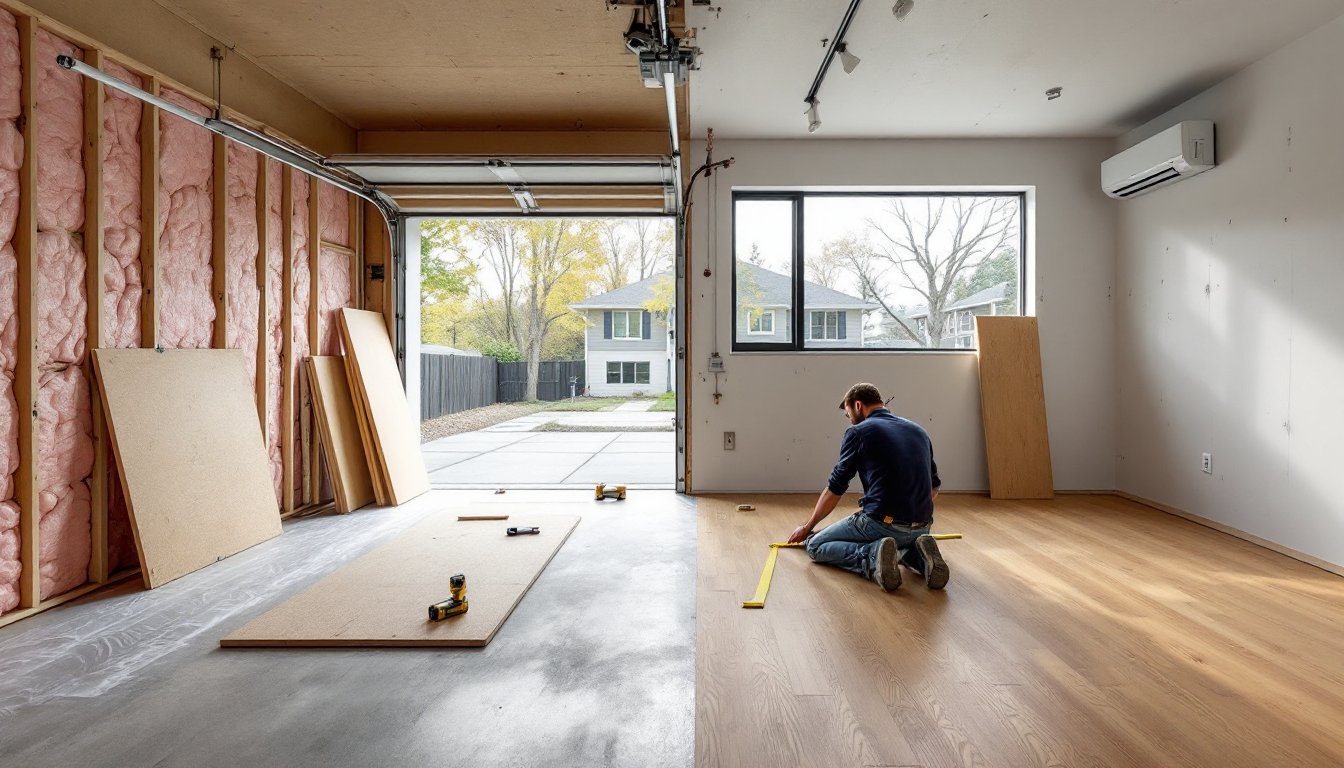
- Subfloor sleepers: 2×4 sleepers laid flat, with rigid foam insulation between them, topped with 3/4-inch plywood or OSB and finish flooring. This raises the floor height by about 2 inches and provides an R-value of roughly R-7 to R-10, depending on foam thickness.
- Polished or epoxy-coated concrete: Works in mild climates but offers no insulation value. Not ideal where winters are cold.
Wall insulation is non-negotiable. Garage walls are typically uninsulated or have minimal batts. The homeowner should fill stud bays with R-13 to R-15 fiberglass or mineral wool, or use foam board if space is tight. Don’t forget to insulate the garage door wall if it’s being replaced with a conventional framed wall.
Ceiling insulation should hit at least R-30, and preferably R-38 or higher in colder climates. If the garage has an attic space above, blown-in cellulose or fiberglass is cost-effective. For flat or low-slope roofs, spray foam may be the better option, though it’s pricier.
Climate control means adding the space to the home’s HVAC system or installing a ductless mini-split. Extending existing ductwork is often the simplest solution if the furnace and air handler have enough capacity. A mini-split provides independent control and works well for ADUs or spaces with separate entrances. Portable heaters and window AC units don’t meet code for permanent heating and cooling.
Adding Electrical, Plumbing, and HVAC Systems
Garages typically have minimal electrical, a few outlets and overhead lighting on a single 15- or 20-amp circuit. Living space requires more. The National Electrical Code (NEC) mandates:
- Receptacles spaced no more than 12 feet apart along walls.
- GFCI protection for outlets near sinks or wet areas.
- AFCI protection for bedroom circuits (if the conversion includes a bedroom).
- Adequate lighting with wall switches at entries.
If the main panel lacks capacity, adding circuits or upgrading the panel may be necessary. It’s worth hiring a licensed electrician for this, DIY electrical work is often prohibited or requires homeowner-specific permits.
Plumbing is optional unless the conversion includes a bathroom or kitchenette. Adding a bathroom is one of the biggest cost drivers, as it requires:
- Running supply lines (hot and cold water) from the main house.
- Installing a drain line and tying into the existing sewer or septic. If the garage slab is lower than the main sewer line, a sewage ejector pump may be required, adding $1,500–$3,000 to the budget.
- Ventilation: Bathrooms need an exhaust fan vented to the outside.
HVAC work depends on the approach. Extending existing ductwork involves cutting into walls or ceilings, running insulated flex duct or rigid metal duct, and adding registers. A mini-split system requires mounting an indoor air handler, running refrigerant lines and a condensate drain through the wall, and installing an outdoor condenser. Both options typically require licensed HVAC contractors and permits.
Popular Garage Conversion Ideas and Layouts
Most single-car garages measure around 12×20 feet (240 sq ft), while two-car garages run 20×20 feet (400 sq ft) or larger. That’s enough room for a variety of uses.
Home office or studio: A single-car garage easily accommodates a desk, storage, and seating. Adding a window (or enlarging the existing one) improves natural light and provides code-required egress. Soundproofing the shared wall helps if the main house is noisy.
Guest suite or ADU: Two-car garages offer space for a bedroom, bathroom, and kitchenette. The layout often places the bathroom along the shared wall with the main house to simplify plumbing runs. A kitchenette with a small fridge, microwave, and sink adds rental appeal but requires additional electrical circuits and plumbing.
Gym or playroom: These uses are less code-intensive since they don’t require sleeping areas or full kitchens. But insulation, flooring, and climate control still matter for comfort.
In-law suite: Similar to an ADU but typically without a full kitchen. Check local zoning, some jurisdictions allow in-law suites without the parking and setback requirements that apply to rental ADUs.
The biggest layout challenge is usually the garage door opening. Options include:
- Framing in the opening with a conventional wall and windows. This is the most common approach and offers the best insulation and soundproofing.
- Replacing with French doors or a sliding glass door to maintain access to a patio or yard.
- Keeping the garage door and insulating it. This works for gyms or workshops but isn’t ideal for conditioned living space, garage doors leak air and are tough to insulate effectively.
Cost Breakdown: What to Budget for Your Garage Conversion
Costs vary widely based on location, finish level, and whether the homeowner hires out all the work or tackles some of it. Here’s a rough breakdown for a 400-square-foot two-car garage conversion in 2026:
- Permits and design: $1,000–$3,000. Hiring an architect or designer for plans adds to the upper end.
- Framing and drywall: $2,000–$5,000. Includes closing the garage door opening, adding interior walls, and hanging and finishing drywall.
- Insulation: $1,500–$3,000 for walls, ceiling, and floor.
- Flooring: $1,200–$4,000, depending on material (luxury vinyl plank on the low end, hardwood or tile on the high end).
- Electrical: $2,000–$5,000 for new circuits, outlets, lighting, and panel upgrades if needed.
- HVAC: $1,500–$4,000 for extending ductwork, or $2,500–$5,000 for a ductless mini-split.
- Plumbing (if adding a bathroom): $5,000–$12,000, including fixtures, drain and supply lines, and a sewage pump if required.
- Windows and doors: $1,000–$3,000. Egress windows cost more than standard ones.
- Finishes (paint, trim, fixtures): $1,500–$3,000.
Total: Expect $15,000–$50,000 for a basic to mid-range conversion without a bathroom, and $30,000–$70,000+ with a full bath and kitchenette. High-end finishes, structural work, or hiring a general contractor will push costs higher.
DIYers can cut labor costs significantly by handling demo, insulation, drywall, and finish work themselves. But electrical, plumbing, and HVAC are best left to licensed pros, both for code compliance and safety. Homeowners should also budget for the unexpected: rotted framing, undersized electrical service, or foundation issues can add thousands to the final bill.