
Table of Contents
ToggleVictorian design doesn’t have to mean stuffy parlors and overwrought wallpaper. A modern Victorian living room takes the architectural richness and decorative confidence of the 19th century, crown molding, high ceilings, and layered textures, and strips away the heaviness. The result? A space that feels curated, not cluttered. This style works especially well in older homes with original trim and tall windows, but even newer builds can adopt the look with deliberate material choices and a restrained color palette. The key is balancing ornate details with clean lines, mixing vintage character with contemporary comfort, and knowing when to lean into drama versus when to edit.
Key Takeaways
- A modern Victorian living room blends 19th-century architectural details like crown molding and high ceilings with contemporary simplicity, avoiding the heaviness of traditional Victorian design.
- Use a restrained color palette of soft whites, warm grays, or muted jewel tones rather than dark, heavy colors, and let materials like velvet, marble, and brass convey quality without excess.
- Balance statement pieces (a tufted sofa, ornate mirror) with streamlined furniture and negative space to create a curated space that feels intentional rather than cluttered.
- Layer lighting with a proportionally-scaled chandelier, wall sconces, and table lamps using warm-white bulbs (2700K-3000K) on dimmer switches for theatrical yet refined ambiance.
- Incorporate architectural details like chair rail, wainscoting, and crown molding scaled to your ceiling height, and refresh original woodwork with matte finishes rather than glossy varnish.
- Edit textiles and accessories ruthlessly—use a single large-scale artwork, oversized mirrors, and minimal mantel décor rather than filling every surface to maintain the balance between Victorian richness and modern restraint.
What Defines a Modern Victorian Living Room?
The modern Victorian aesthetic is a hybrid. It borrows the architectural bones of Victorian homes, crown molding, wainscoting, ceiling medallions, and corbels, but ditches the dark wood stains and busy florals that can make traditional Victorian interiors feel dated.
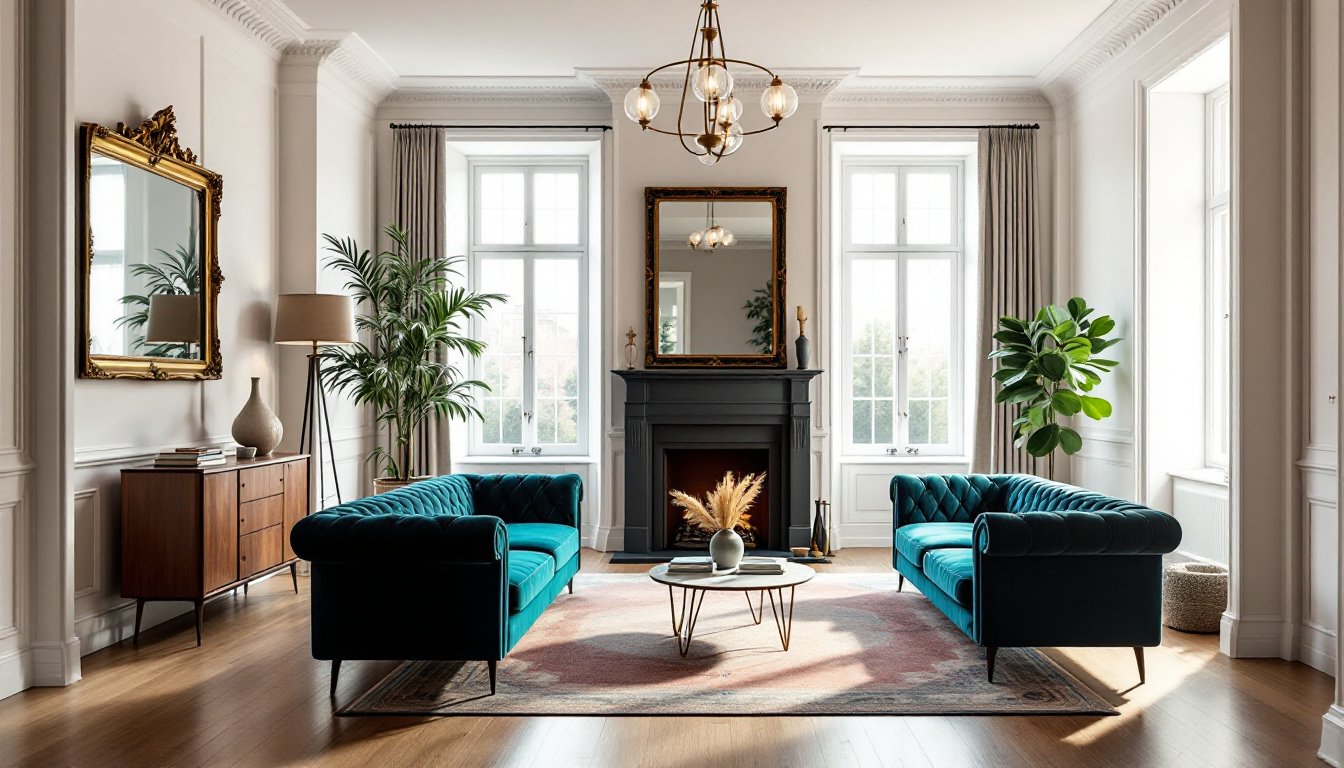
Instead, the palette lightens up. Walls are often painted in soft whites, warm grays, or muted jewel tones like dusty emerald or charcoal blue. Woodwork gets refreshed with matte or satin finishes rather than glossy varnish. Furniture follows a similar philosophy: a tufted Chesterfield sofa might sit across from a low-profile mid-century credenza. The contrast is intentional.
This style also embraces negative space. Victorian rooms were packed with objects, every surface held a tchotchke. Modern Victorian design curates instead. A single vintage oil painting over the mantel carries more weight than a gallery wall of prints. An antique mirror leans against the wall rather than being flanked by sconces and dried flowers.
Materials matter. Look for velvet, linen, brass, marble, and reclaimed wood. These materials telegraph quality without shouting. If the home already has original plaster, wood floors, or built-ins, highlight them. Sand and refinish floors in a natural or light stain, skip the orange-toned polyurethane that was popular in the ’90s. If trim has been painted over in layers, a careful chemical stripper (use PPE: respirator, gloves, and eye protection) can reveal the original wood, though repainting in a modern shade is often more practical.
Essential Color Palettes for Modern Victorian Design
Victorian interiors historically leaned into deep reds, forest greens, and navy blues, often paired with dark wood and heavy drapes. Modern Victorian lightens that foundation but keeps the richness.
A common approach: neutral walls with jewel-tone accents. Paint the main walls in Benjamin Moore’s White Dove or Sherwin-Williams Alabaster (both warm whites that don’t read sterile), then introduce color through a single accent wall, upholstery, or drapery. Accent colors might include charcoal, plum, teal, or burnt umber.
Another route: monochromatic schemes with texture doing the heavy lifting. A living room in varying shades of gray, from pale dove to charcoal, stays cohesive but avoids flatness when materials like velvet, wool, linen, and silk are layered in.
For those with original woodwork, consider painting trim and molding in a contrasting color. White walls with matte black trim create sharp definition. Alternatively, paint everything, walls, trim, ceiling, in the same shade for a cocooning effect that highlights architectural details through shadow rather than color contrast.
Ceiling color deserves mention. Many Victorian homes have 10- to 12-foot ceilings. Painting the ceiling a shade darker than the walls (or even a soft blush or sage) can make the room feel more intimate without losing the volume. If there’s a plaster medallion or decorative cornice, a contrasting ceiling emphasizes it.
Furniture Selection: Balancing Ornate and Streamlined Pieces
The furniture mix is where modern Victorian either clicks or tips into chaos. The formula: pair one or two statement pieces with simpler supporting furniture.
A tufted velvet sofa with rolled arms anchors the room but needs counterbalance, think a sleek marble coffee table with hairpin legs or a glass-top table with a minimal brass frame. Avoid matching suites. A Victorian-style armchair can sit beside a modern wingback upholstered in linen.
Wood furniture should vary in finish. A dark walnut side table works next to a blonde oak bookshelf, as long as the styles don’t compete. Look for pieces with tapered legs, carved details, or inlay work on the vintage side, and clean geometric forms on the contemporary side.
Seating arrangements should encourage conversation, a Victorian holdover. Arrange furniture in a U-shape or L-shape around a central focal point, fireplace, large window, or coffee table. Avoid pushing everything against the walls: floating furniture creates intimacy in larger rooms.
If the budget allows for custom work, consider built-in shelving flanking a fireplace or window. Use solid wood face frames (poplar or maple if painting, oak or walnut if staining) and adjustable shelving with brass or steel pins. Paint built-ins the same color as the walls to make them recede, or in a contrasting color to highlight them.
Architectural Details and Molding
If the home lacks original trim, adding it transforms the space. Crown molding comes in profiles from 2 inches to 12+ inches, scale it to ceiling height. For a 9-foot ceiling, a 4- to 6-inch crown is proportional. Larger is fine for 10-foot-plus ceilings.
Install crown with a compound miter saw: inside and outside corners require precise angles (typically 33.9° bevel and 31.6° miter for 52/38 spring angle crown, though this varies by profile, check the manufacturer’s specs). Use a coping saw for inside corners if the walls aren’t perfectly square: coped joints are more forgiving than miters.
Chair rail (typically installed 32 to 36 inches from the floor) and picture rail (usually 8 to 10 inches below the ceiling) add horizontal definition. Wainscoting or board-and-batten paneling on the lower third of walls reinforces the Victorian feel. Use 1×4 or 1×6 boards (actual dimensions 3/4″ x 3-1/2″ or 3/4″ x 5-1/2″) for battens, spaced 12 to 16 inches apart. Prime all sides before installation to prevent warping, and fill nail holes with lightweight spackle before painting.
Lighting Fixtures That Bridge Both Eras
Lighting is where modern Victorian design gets theatrical. Victorian homes relied on gas lamps and later early electric fixtures, which were ornate and often brass or crystal. Modern versions scale back the embellishment but keep the material richness.
A chandelier is almost non-negotiable. Look for fixtures with mixed materials, brass arms with glass globes, or wrought iron with Edison bulbs. Size matters: for a living room, measure the room’s length and width in feet, add them together, and convert to inches for the fixture’s diameter (e.g., a 14′ x 16′ room suggests a chandelier around 30 inches in diameter). Hang it so the bottom is 7 feet minimum from the floor, higher if ceilings allow.
Layer in wall sconces flanking a fireplace or mirror. Choose sconces with fabric shades or seeded glass for a softer look, or go minimal with plug-in swing-arm sconces in matte black or brass, easier to install than hardwired and no electrical permit needed.
Floor lamps and table lamps should mix styles. A tripod floor lamp with a linen shade pairs well with a vintage banker’s lamp on a side table. Use warm white bulbs (2700K to 3000K) throughout: cooler temperatures read too clinical.
Dimmer switches are essential, install them on all overhead fixtures. A basic single-pole dimmer is a straightforward swap (turn off the breaker first, and use a non-contact voltage tester to confirm the circuit is dead). Most dimmers work with LED bulbs now, but check compatibility to avoid flickering.
Textiles, Patterns, and Layering Techniques
Victorian design was texture-forward: velvet drapes, needlepoint cushions, Persian rugs, fringed throws. Modern Victorian keeps the layering but edits the palette and scale of patterns.
Start with a large area rug, either a traditional Persian or Oriental rug in muted tones, or a modern geometric pattern in complementary colors. Rug size matters: in a living room, the front legs of all major furniture should sit on the rug, or the entire furniture grouping should fit within it. For a standard seating area, that’s often an 8′ x 10′ or 9′ x 12′ rug.
Drapery should be floor-length, mount rods 4 to 6 inches above the window frame and extend them 6 to 12 inches beyond each side of the window to make windows appear larger. Use linen or cotton-blend panels in solid colors for a modern look, or damask or brocade for Victorian richness. Opt for ripplefold or tailored pleats rather than pouf valances.
Throw pillows are the easiest place to introduce pattern. Mix solids, stripes, and one small-scale floral or damask. Odd numbers (three or five per sofa) look more natural than even sets. Vary pillow sizes: pair 22-inch square pillows in back with 18-inch or lumbar pillows in front.
Upholstery fabric should span the spectrum. A velvet sofa balanced by linen armchairs keeps the room from feeling too precious or too casual. If reupholstering vintage furniture, choose performance fabrics, modern weaves that mimic natural fibers but resist stains and wear.
Accessories and Finishing Touches
Accessories make or break the modern Victorian balance. Too many, and the room reads cluttered: too few, and it feels cold.
Mirrors are foundational. Oversized mirrors with ornate gilt frames or simple black frames reflect light and amplify space. Lean a large mirror against the wall rather than hanging it for a more relaxed feel.
Art should be large-scale and carefully chosen. A single piece of abstract art or a vintage oil painting works better than a dense gallery wall. If going with multiple pieces, use identical frames and symmetrical spacing.
Books displayed on shelves or coffee tables add warmth. Mix orientations, some stacked, some upright. Add a few decorative objects like brass candlesticks, a ceramic vase, or a vintage clock, but edit ruthlessly.
Plants soften the formality. Large potted plants like fiddle-leaf figs or rubber plants fit the scale of high-ceilinged rooms. Use ceramic or brass planters rather than plastic nursery pots.
Fireplace mantels are prime real estate. Keep decor minimal: a large mirror or piece of art above, flanked by a pair of candlesticks or small sculptures on the mantel itself. Avoid overcrowding.
Finally, don’t neglect hardware. Swap builder-grade doorknobs and hinges for matte black, brushed brass, or oil-rubbed bronze options. It’s a small detail that reinforces the intentionality of the space. If replacing hinges, match the existing screw holes or fill old holes with wood filler and drill new pilot holes to prevent splitting.